
ART
Perrotin London Presents Daniel Arsham’s Time Fold
BY VANESA KRIZONYTE
Imagine this page is a hotel notepad. A space where scattered thoughts remain unedited and free to brew without the pressure of refinement. Daniel Arsham’s practice is where past and present coexist, and any raw idea, even a sketch on a hotel notepad, is part of his future creations. This review adopts the form of a hotel notepad, collecting first impressions.
Contemporary artwork often revisits past periods and fuses styles. For Daniel Arsham, references to the past are not a source of inspiration or reinterpretation but rather a redefinition of history. The Time Fold exhibition at Perrotin London maps out Arsham’s multidisciplinary career not as a chronology, but as an interconnected dialogue – in his hands, every creation is in the process of becoming something else. The exhibition offers rare insight into Arsham’s gouache studies, hotel sketches, and the development of ideas that later emerge as large-scale works.
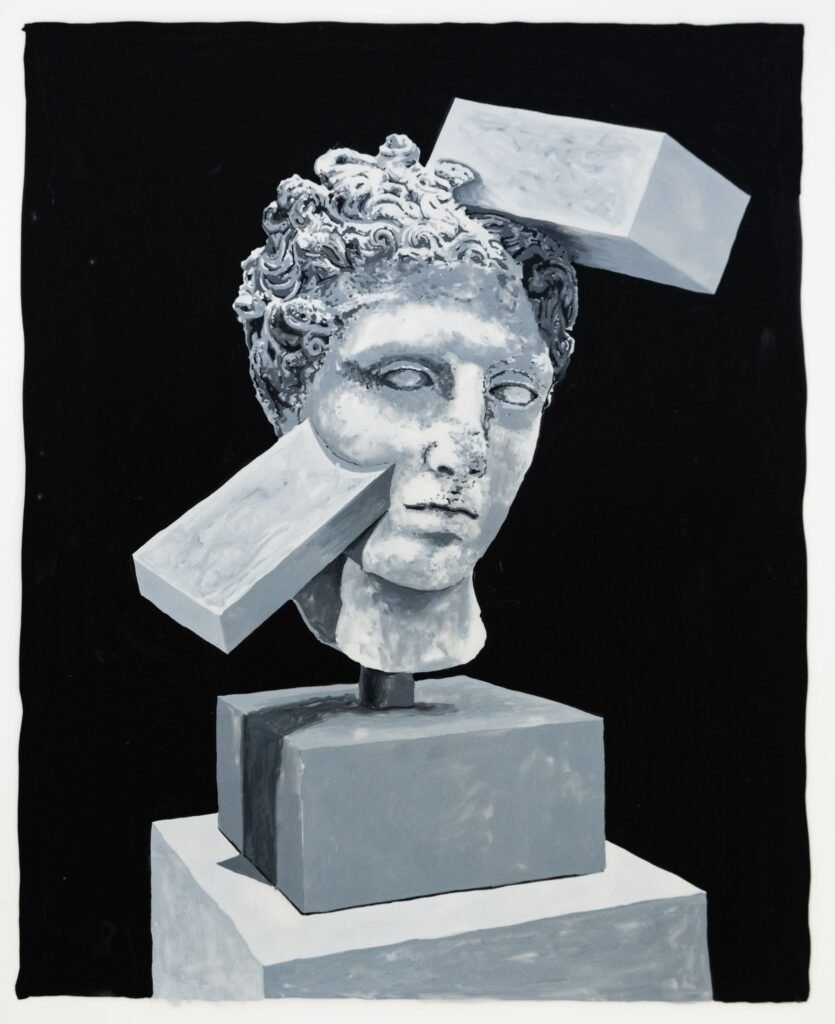
Daniel Arsham, Portrait Bust of Duke Nemours and Floating Geometry, 2007, Gouache on mylar, 37.1 x 29.2 cm, Courtesy of the artist and Perrotin.
The show is divided into two gallery rooms with parallel plinths holding his sculptural forms surrounded by hanging sketches, studies, and paintings. The exhibition is centred on “becoming a site of execution not only of objects but of the artist’s own history.” As seen in the Relics in the Landscape exhibition at Yorkshire Sculpture Park, Arsham tends to challenge notions of time by manipulating history and incorporating scientific decay. In this exhibition, there is an opportunity to discover previously unseen gouache studies, including one of a Pentax K1000 camera, gifted to him at age 10 by his grandfather. The medium of gouache allows forms to emerge through light and shadow in ways graphite alone cannot. Fragments of crystallisation in the sculptural camera show where objects are treated as living entities subject to growth, progression, and transformation. The camera will experience fragility, but the photographs remain fixed to the time of capture. Essentially, the camera from the 1970s and Greek antiquity occupy the same speculative archaeology.
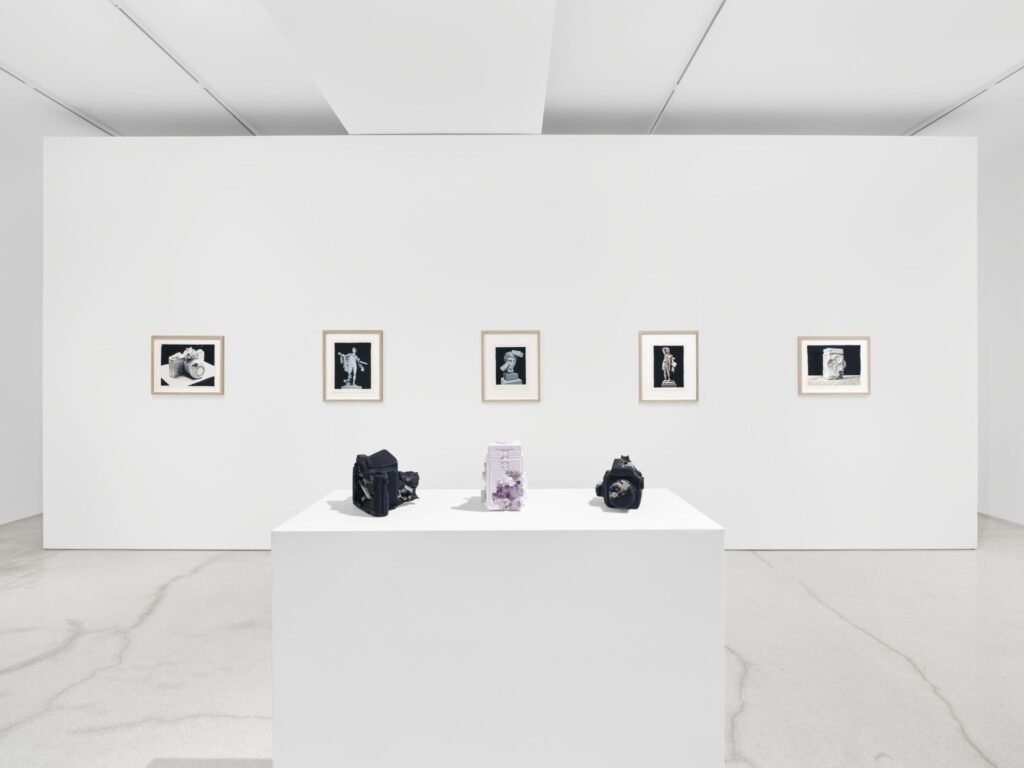
Views of Daniel Arsham’s exhibition ‘Time Fold’ at Perrotin London, 2026. Photo: Eva Herzog. Courtesy of the artist and Perrotin.
Arsham is known for finding creative freedom within new spaces. The gallery invites insight into his rare sketches on hotel notepads. The nature of hotel paper carries traces of place, date, and specific journey. In line with Arsham’s concept of time, the sheets contain visible hand smudges and traces of graphite around the sketches, forming a stamp for the birth of ideas.
From 2003, Perrotin recognised Arsham’s talent through his early drapery work. His practice is deeply rooted in architectural studies, and archaeology fuses into sculptural expressions. The female sand bust displayed in the second room demonstrates a new approach to sand – forming a Greek silhouette filled with historic narratives. The structure reads as a map of the mind, with interconnected rooms suggesting emotional states and fragments of memory. Notably, the figures walking through the rooms spread a visual symbol of the way thought moves through us. Sand is often associated with erosion and the passing of time, yet it holds a structural composition, creating a symbol of psychological architecture. It forms a reminder that the subconscious is built from things that feel fleeting yet shape the foundation of who we are. The use of Greek themes is not to mourn the past but rather to propose a relation with the future.
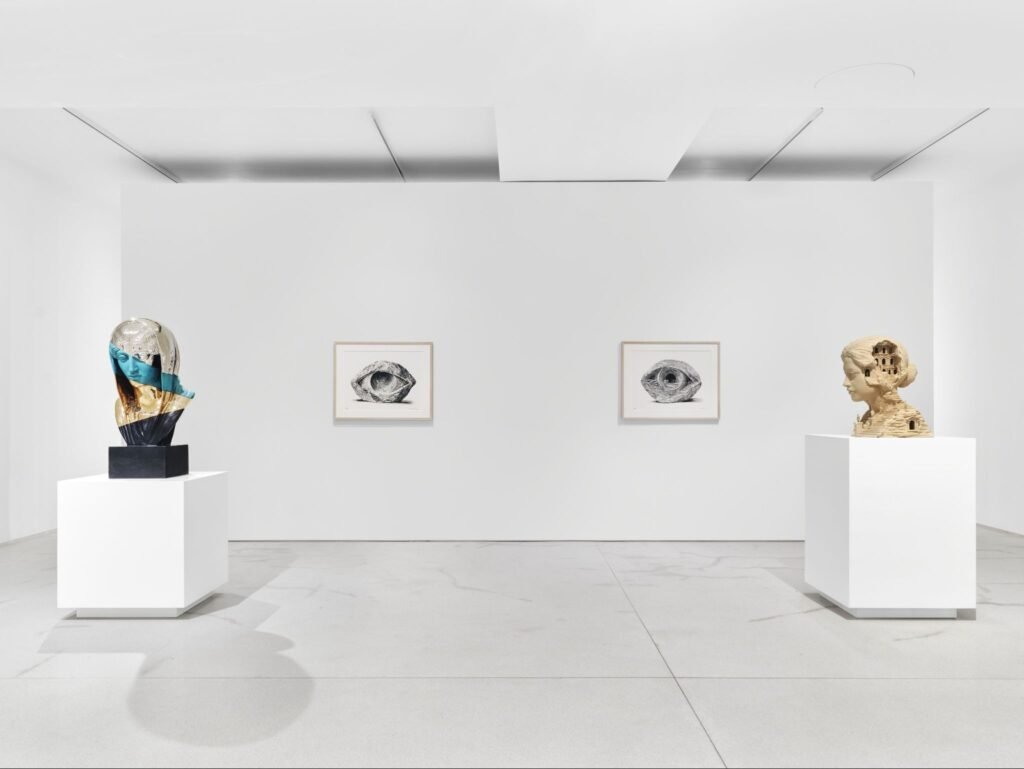
Views of Daniel Arsham’s exhibition ‘Time Fold’ at Perrotin London, 2026. Photo: Eva Herzog. Courtesy of the artist and Perrotin.
Investigating the works closely, Time Fold offers an insight into the interconnections in Arsham’s practice. By bringing preparatory studies into direct conversation with completed works, Time Fold succeeds in making the artist’s creative process as significant as the objects themselves. Rather than presenting history as fixed, the exhibition proposes a philosophy rooted in the ongoing process of transformation, where memories, objects, and ideas remain in presence.
On Thursday 18th June 2026, from 5 to 7pm, a warm invitation is extended to join Daniel Arsham at Perrotin, London, for an exclusive book signing of the latest book, Future Relic: Failures, Disasters, Detours, and How I Made a Career as an Artist.
Deepest gratitude to Loris at Perrotin London for Press Accreditation and Imagery Rights. Published June, 2026.
